Showing posts with label David Cunliffe. Show all posts

Sunday, 26 October 2014

Musings on New Zealand's Rape Culture, Domestic Violence and Apologies.

One in five women over the age of 15 have experienced some form of sexual violence according the New Zealand National Survey of Crime Victims.  Australia has a similar level of sexual violence towards women.  Apparently the rates in New Zealand and Australia are double the global average - and that is based on the reported incidents only.  Yet we continue to debate the existence of a rape culture in New Zealand.


Before the election a several stories blew up regarding domestic violence, rape and sexual assault in our media.  The way two of the stories were handled was appalling.  The other was blown all out of proportion and sensationalised and ridiculed by our so called journalists.

So the first appallingly handled incident was the Malaysian diplomat's attempted rape/sexual assault on Tania Billingsley on 9th May.  She did the right thing and contacted the police asap.  Apparently the diplomat even waited for the police to turn up.  Muhammad Rizalman was arrested and charged by the police with the view to prosecute.  Tania says that the police have been very supportive and helpful throughout the ordeal.

Who wasn't, however, was the Ministry of Foreign Affairs (MFA)s, when during discussions with the Malaysian embassy about the Rizalman's charges and going to court, cocked the whole thing up by suggesting that diplomatic immunity be invoked and a quick trip home could sort it out.

What made it worse was that the Minister of Foreign Affairs, Murray McCully, knew fairly early on that this attack happened and who was involved.  He informed the Prime Minister.  And then Murray McCully never followed up on what happened with the case, and seven weeks later it came back to bite him and the Prime Minister on the rear end.  Then it emerged that an email detailing events sat unopened in Mr McCully's inbox due to "communication difficulties" as he visited New York.  Gee, I didn't know New York had such poor internet connections.

In the meantime, diplomatic immunity was invoked (Malaysian authorities say it was at the suggestion of our officials from MFA) and the Rizalman was sent home on 22nd May with the promise of him facing a military court/discipline as he was an envoy of the armed forces.  When the story broke here a big uproar happened.  Malaysia agree to send the man back, and the next thing you know he is in a mental health facility.  He has since been released, yet we waited several months for his return to New Zealand.  He has arrived in New Zealand in late October, five months after the incident occurred!

Meanwhile Tania Billingsley went to court to get the name suppression covering her lifted so she could speak out.  She was interviewed by TV3's 3rd Degree, who were very careful to make sure nothing was aired that would endanger the court case.  I think getting the name suppression lifted and speaking on national television was a bold move by Tania.  I see it as a strong move to reclaim power that was taken from her during the attack.

However media and commentators slammed her move and claimed it was politically motivated because she is active politically and due to her comments regarding Murray McCully and John Key's actions, or lack there of, as this case has unfolded.  Claims were made that Jan Logie, an MP from the Green Party, had politicised Tania's case to attack the government.  I consider Tania's condemnation of McCully and Key to be well founded.  Murray McCully completely dropped the ball and John Key was his usual dismissive self.

And then there are the outrageous claims made on Whale Oil's blog about her intentions and attacking the integrity of Tania Billingsley and the details of the incident itself  -  I believe he even claimed that she had set up the attack as a trap!!

Over five months since the original incident, Rizalman has returned and had his first court date and been remanded in Rimutaka Prison.  (NZ Herald Red faces over Malaysian diplomat October 26th).

Which brings us to the overblown story....

In the midst of this, David Cunliffe attended the Women's Refuge conference.  Most of the parties were represented, and I know that Paula Bennett attended for National and Metiria Turei for the Greens.  After Paula Bennett had finished her speech she then proceeded to use her phone during the remainder of the other speeches, ignoring the other speakers completely, according to a source through Twitter who was also attending.

David Cunliffe led his speech with an apology.  He apologised for being a man because most domestic violence on children and partners is perpetrated by men.  The head of Women's Refuge said his speech was inspirational.  The media and commentators and John Key slammed him for apologising.

Most people have only seen that short clip when David Cunliffe apologises for being a man.  The media did not show the rest of the speech, or even the following couple of sentences, to give that apology context.  But personally I support him for apologising.  I respect the fact that Cunliffe was man enough to say that physical and emotional family violence is not ok and that men are the abuser in a majority (not all) of cases.  The Dim Post's blog post On Cunliffe's apology for being a man says it so well.

I wish that more men were man enough to say that abusing women and children is not the manly thing to do.  It would go a long way towards addressing the abuse suffered in this country in far too many homes across the socio-economic and ethnic spectrums.


John Key made much of ridiculing David Cunliffe's apology for being a man, but at the same time his government denied extra funding to the Christchurch Rape Crisis Centre which was forced to close as a result.  It does not make for a woman friendly government or one that cares about the wellbeing of its citizens when they are most in need of support.

But waiting to emerge was another story of a victim of sexual assault whose case had been handle appallingly as  well.

The victim lived in Queenstown.  She was indecently assaulted in her own home, with her daughter nearby, by an extremely well known individual.  This happened quite a while ago now, and the case has been through the courts.  The judge did not put a conviction on record for this well known man due to the hardship he had supposedly suffered due to the court case.  He was also granted permanent name suppression.  What the......?  Consequently the victim is very upset about the lack of a conviction and the victim wants the name suppression to end. 

In the aftermath of the Rolf Harris case, when due to his conviction and sentencing, a raft of accusations have flooded out, including from National MP Maggie Barry, Rodney Hide, the former ACT leader, made a call in his Herald on Sunday column for Maggie Barry to name this well known man under parliamentary privilege.  Hide claims that more victims may then come forward if they knew he was the perpetrator in the Queenstown assault.

You can read more in Forget Rolf, Maggie.  We have our own sexual predator to name and shame and Rape culture protects predators.

This was a hot topic on Twitter.  And it was through a direct message (not seen publicly because DMs are private) on Twitter that I found out who this very well known man is.  I won't be publishing his name.  It is a man with a very wide known profile, possibly not to the younger set, but definitely to my generation and up.  He has been a public figure in at least three different arenas that I know of, and I can understand why the woman at the centre of the case initially felt comfortable to invite him into her home.  Like Rolf Harris, this man earned trust because of his public persona.  And like Rolf Harris he has used the cover of his public persona  to abuse - and we would probably find out about more abuses of trust if his name was released publicly.

Alas, no one told David Cunliffe who this man was, and when he was on his busman's holiday in Queenstown with his family during the July school holidays, Cunliffe met with this man.  Oh the public outcry!  Oh the media beat up!!  Personally I was amazed that considering New Zealand pretty much has two degrees of separation between any two people that he didn't know who the man was.

David Cunliffe was very apologetic afterwards, saying he would not have met with that individual if he had known the charges the man had faced and the outcome.  (NZ Herald Anonymous attack over holiday upsets 'recharged' Cunliffe 21 July 2014).  But here again, we have something blown up to an extent that it clouded over the real issue: a woman was sexually assaulted in her own home and the courts denied her justice.

This woman has also fought in the courts for the right to have her name suppression lifted in order to expose this high profile New Zealander.  Louise Hemsley has now been able to tell her story, but her offender still has name suppression.  She is horrified that he has essentially gotten away with the assault with no repercussions, that justice is not served.  On the Sunday programme, in a piece called Justice denied? Mrs Hemsley has been able to tell her story and how the offender was allowed to plead guilty to a lesser charge that sanitised what actually took place and left her victim impact statement effectively useless during sentencing.

He has also spoken to the Herald on Sunday this week, telling them that it was 20 seconds of madness that have almost cost him his marriage, prevented him from securing employment, resulted in a depletion of his saving from legal fees and that his children no longer speak to him.  He regrets that he took the legal advice to plead guilty as he considered the incident to be consensual.

But Louise Hemsley needs to be celebrated because her main goal in telling her story is to prevent her attacker going on to further victims.  She want him to know what he did was not ok, that it does have consequences, not only for her and her family, but him and his family.

All of this comes after the revelation late last year of the Roast Busters, an on-going scandal involving a group of young men based in Auckland who allegedly sought to intoxicate underage girls to gang rape them, and the police response (or perceived lack of response) to the complaints of alleged victims.  Police spokesmen claimed they had been aware of the group and had been monitoring their Facebook page for two years, but had not begun prosecution because no alleged victims had made formal statements or complaints. However, it was later reported that a number of young girls had made complaints in 2011 and 2012, but they were told there was not enough evidence to proceed.  And this still remains unresolved.

Many women are now trying to expose their abusers to the public.  Karen Beaumont and Anne-Marie Forsyth are trying to expose their abuser 20 years after he was convicted.  Despite getting their own name suppression lifted, the judge would not lift the suppression of their abuser's name.  Their abuser argued that it would be unfair to lift the suppression order on his name. 

In the September 2014 issue of The Australian Women's Weekly, journalist Jessica Leahy detailed her own experience of sexual assault and how the culture of women and girls being polite and not making a fuss results in sexual assaults being tolerated and under reported.  Leahy writes: 
"And our culture seems hell-bent on conditioning us to be easy prey.  We are raised not to be rude or bossy or difficult and, above all else, not to be a bitch. 'Be nice' is a well-versed mantra often recited to the fairer sex, but it's becoming clear that it is this courteous behaviour that can get good girls into bad trouble...
 
"So many women, myself included, don't report the kind of incidental sexual harassment they encounter because it happens almost daily.  Numbed by repeated exposure to it, it's become normalised.  And that is terrifying."

And Ms Leahy is so right.

New Zealand has an appalling rate of sexual abuse, domestic violence and sexual assault.  Some children, some wives and partners live it on a daily basis.  Some have suffered it on a lesser scale less often.  Some have a sudden and traumatic attack.  None of these scenarios are acceptable.

And while I have generalised here that men are the usual perpetrators, I am aware that domestic violence, and even sexual violence, can be perpetrated by women as well.  Sadly, this is often overlooked and not given enough attention either.

Earlier this year I was at a beach town pub playing pool with a couple of girlfriends, one a married woman.  My best friend's husband, brother in law and an old school friend of ours turned up with some other blokes.  They were on a boy's weekend away.  My old school friend has his brother in law in tow.  I hadn't met him before, and I'm sure my friends and I don't want to meet him again.  (In fact my friend's husband has decided never to take him on a boy's weekend again due to his poor behaviour while intoxicated).

Why?  Because this guys was "handsy".  He groped, he touched, he rubbed, he was over amorous.  Now it seems pretty low level, but because we didn't want to make a scene, because we were being polite, we've allowed this man to think that his behaviour is acceptable and that he can do the same thing in the future.

So many hide the fact that they have been sexually assaulted or domestically abused.  They don't want to bring shame on themselves or to break up the family.  Many are scared of being labelled as liars or of the legal process that is vicious towards the victim. 


I know a family where a member has molested one of the girls from early adolescence through most of her teenage school years.  Then he also had the gall to try it on with four other of his younger relatives in either their own homes or the home of his grandmother.  Some of the girls told an adult in the family and things were swept tidily away and the decision was made to send this person off to another part of the country.  Some of the girls kept silent, only talking to one or two others on the off chance they had been affected.  That person has gone on to offend against other girls in other families.  He now has convictions and a jail sentence for those acts - but who else has he offended against and that has been kept secret?  If his own family had not kept things so hush hush, but had dealt with his offending properly and got help for him and his victims, would these other offences have happened?

But it is not only families that keep it hush hush.  Did you read Nicky Hager's book Dirty Politics yet?  Well page 115 is a revelation:

As an example, without using people's names, when David Farrar organised a 'Princess party' for National Party friends, a conversation between some of the planned guests was approvingly reported.  One man said to another, 'I have cleared the field for you, given you the most likely targets and will get them drunk for you.'  Another said, 'I'd try [a young woman] she is filthy.'  The Young Nationals women were described as 'retards' and 'just dirty girls who flip it up'.

This is what happens in National Party circles?  Shit, I'm glad I'm not a female Young Nat!!

It also makes a mockery of John Key with his condemnation of the Roastbusters situation in November 2013.  The Hand Mirror blog's post National party alleged rape culture sums it up succinctly: 

A grown man wants kids to “grow up” and presumably grow out of the toxic rape culture they seem to be embracing.
And what are some of the fully grown adult male supporters of the national party doing?
Deliberately getting young women drunk and pointing out “easy targets” for other National party supporters.
National party; these are your men, your party, your culture. This is your problem.
The fact that someone allegedly sent this email means that they feel so comfortable with the idea of what they are planning to do they were happy to write it down. Comfortable with seeing women as a faceless commodity. Comfortable with the idea that they have the right to compromise the sobriety of women, and deliberately pass “references” on to a group of men.
This comfort means that the rape culture is pervasive, it is normalised, and it is persistent.

The Hand Mirror blog has a number of posts that address the rape culture we have in our society:
The Hand Mirror blog has many more gems like this.  If you click on the tag Rape Is Not OK in the label section you can see a full list of blogs pertaining to this subject.

The last blog post listed above brings to mind a recent incident from Otago University with a Facebook page that caused outrage called Rack Appreciation Society.  On this page members shared explicit photos of women without their consent.  Several women stood up and alerted authorities and the media.  The student behind the page, Sean McDonald, claimed the page had gotten out of control and was not meant for sharing photos of local women.  Rather, members were supposed to share pictures of professional models.  (Read more on the NZ Herald article Man behind 'rack' Facebook page says sorry).

Marianne Elliott grew up in Tokoroa.  She has been part of a team documenting rapes and sexual assaults in Afganistan.  In November 2013 she wrote a post about her experiences of rape culture in New Zealand and around the world in response to the Roast Busters revelations, There is a reason I was afraid to get drunk at rugby parties.

I remember being at parties as a teenager and looking around at my friends – my male friends – and asking myself ‘Can I trust him? Would he do anything to prevent someone else taking advantage of me? Would he do it himself?’

I remember looking at the boys I liked and wondering, ‘Would he take advantage of me if I was drunk? Would he even know that was what he was doing was wrong? Would he tell other people that it had happened?’

That is rape culture.

Because that’s how I thought of it – not as ‘rape’ but as someone ‘taking advantage’. Someone seizing the opportunity I had given them, by being drunk. So I didn’t get drunk. I never drank from the keg. I took my own drinks to parties, wine or wine cooler, shared it only with my best friend and kept it out of sight so no-one could tamper with it.

There’s more to say about men and sex and my teen years. But this is what matters for now – I was always afraid. I was afraid that if I took any risks, something bad could happen to me and it would be my fault.

That’s rape culture. It’s what I grew up with....

But as my book tour continued, stories kept appearing across the US and Canada. Stories of girls who had been raped, blamed, shamed and shunned. Stories of boys who believed they had done nothing wrong. Stories of entire towns that stood in support of their ‘decent boys’ who had just made a stupid mistake. Stories that were as painful, to me, as anything I’d seen in Afghanistan.

That is rape culture. And it is everywhere. But it’s not inevitable.

So why do we protect these 'decent boys'?  Do 'decent boys' actually behave like this?  Is it acceptable?

I do want to acknowledge that men can also be subjected to sexual violence.  The revelation in September of a backpacker's own, Michael Harris, stupefying, raping and photographing his male victims who were staying at his establishment demonstrates that men can easily be victims too.  (Radio NZ Fresh charges for backpackers' owner 24 September 2014).

While most of this post has been about rape culture, one can not ignore the fact that New Zealand has a very damning culture of domestic violence.  These statistics from the Women's Refuge website are sobering to read:

One in three women experience psychological or physical abuse from their partners in their lifetime1.

On average 14 women, six men and 10 children are killed by a member of their family every year.

Police are called to around 200 domestic violence situations a day – that’s one every seven minutes on average.

Police estimate only 18% of domestic violence incidents are reported.

At least 74,785 children and young people aged under 17 were present at domestic violence situations attended by police.

84% of those arrested for domestic violence are men; 16% are women.

The economic cost of domestic violence was estimated at $1.2 to $5.8 billion per year by economist Suzanne Snively in 19962. In today’s figures, that would be up to $8 billion.

In the 2009/10 year there were 3,867 domestic violence cases in the Family Court which each involved at least one child.


New Zealand is failing the standard on keeping women, children and vulnerable men safe from abusers.  As a society we have allowed a rape culture to permeate beneath the surface of our every day lives and minimise the incidents that some men do, allowing them to think their behaviour is ok, so then they escalate.  We need to teach our young boys as they grow that the rape culture is not ok, it is not normal.  Our grown men need to take a good hard look at how they behave, because for some of them they have lived the rape culture, and it is not ok.


Footnote:  A few days after publishing this blog post the New Zealand Police announced that no charges would be placed despite formal complaints from seven young girls.  The Police said 25 other girls refused to be formally interviewed and that even one of the accused refused to participate in an interview.  A few days later, on Q&A on TV1, Paula Bennett, a government minister, said she supported the Police decision.  Naturally, there are some upset people about the lack of charges and the attitude of the government.  And New Zealand does not have a rape culture?

Sunday, 28 September 2014

Labour Leadership - Here We Go Again...

Labour, the other Saturday, plunged to its lowest place in the polls in its nearly 100 year history.  Some polls had warned that Labour was slipping in the polls in the weeks leading up to the election, but internal polling had indicated higher numbers, and the door knocking and phone calling had also indicated positive responses to people supporting and voting Labour. 
 
Combined with National slipping bit by bit in the polls following the Dirty Politics book release and Judith Collins' inappropriate behaviour being fully exposed, how buoyant the Greens had been in the polls and the fact that New Zealand First's policies and people seemed to lean more towards the left than the right, I was confident that the election would be on a knife edge.  I honestly thought a clear winning team would not be evident on the night.
 
Oh how wrong I was, and many others.
 
With National winning 41 electorate seats and 48% of the party vote to get an extra 20 List MPs, it meant they had 61 MPs out of 120.  John Key also moved in the next few days to make doubly sure he had the House in his grasp by opening discussions with his "friends" from the last six years: the Mäori Party, United Future and ACT (who shouldn't be there - but that is another discussion).
 
 
Meanwhile, predictably, Labour was tearing itself apart.  Just like in November 2011, the leader was blamed.  David Cunliffe was vilified for his speech at the end of election night (the one where he celebrated the work of all the party volunteers and supporters - and right that he did, because we worked bloody hard) and his lack of resignation on the spot.  As someone pointed out on Twitter recently, did Helen Clark's election night resignation set the benchmark for the losing leader?
 
 
In the days that followed, Cunliffe was continually criticised for his blaming Kim Dotcom for the failure of the left to thrive, for blaming the Dirty Politics book for sucking up tv air time, for not taking responsibility for his role in Labour plunging to a new low, for not resigning, for gagging his MPs....
 
Then there was the various Labour MPs speaking to the media about why they thought Labour had gone down in the polls and what they think should happen next.  Followed by the 7.5 hour horror caucus meeting on Tuesday and the angst and hair pulling since then, the membership of Labour became even more concerned and, just like within the caucus, people have started aligning themselves with their preferred leader, including several Facebook pages that support David Cunliffe in continuing his leadership of Labour.


And then there were the bloggers, journalists and media commentators who weighed in with accurate comments and the crazy off the mark comments too.


On Saturday, David Cunliffe resigned his leadership, taking responsibility for the election loss, and then nominated himself for the leadership vote.  Grant Robertson also put his name back into the hat.  David Shearer had indicated that early last week that he was considering a bid, but as he has been in New York at the UN with Murray McCully the last few days, this has yet to materialise at the time of writing this blog. 


Other names that have been thrown about include Kelvin Davis (who ruled himself out - including to me in a tweet), Jacinda Ardern and Andrew Little (who are playing that coolly, particularly as Little has to wait for the confirmed election results on October 4th to know he really is the 5th list MP for Labour) and, strangely, Stuart Nash (who, while he has run a great campaign to win Napier back, was helped by the fact that Garth McVicar split the vote on the right when he ran for the Conservatives and a new National candidate).
 
 
I note that the commentators and journalists have not aimed similar vitriol at the Greens or NZ First for their performance on Election Day.  Neither of those parties reached their predicted percentage of the votes, in fact the Greens have one less MP than they had in the last parliament.  And I'm not the only one to notice....
 
 
After David Cunliffe announced his intentions on Saturday, Sue Moroney posted this on Facebook:
 
 
I had been wondering Sue's point of view since Tuesday's caucus meeting where she resigned as Chief Whip (which she explained in another post she had done so to concentrate on her portfolio areas).  Consequently I was very pleased to see the above post.  I believe that people become MPs because, apart from their desire to enter politics and serve the country, it is the people behind them, the party members, who do the hard yakka to get that MP into parliament. If you do not recognise those who help you and feed back to them then the relationships you develop during the campaign will not exist for the following campaign.
 
Below is my response to Sue on Facebook:
 
I personally think that DC will have learnt a lot over the last year and that experience of learning on the job is irreplaceable.

It took Helen Clark & co 6 years to win the Treasury Benches after she became leader and she had some big hurdles and an election loss. It took her time to build her relationships as leader and with NZ.

This stuff doesn't happen overnight.

One of the reasons I joined Labour was the ability of the membership to have a say in who leads the party. So I'm pleased that DC and Grant are honouring the process set down by the party rules.

But after that process is over, the factions need to dissolve and the backstabbing needs to end. And not just in caucus.  I've been appalled to see it in the organisation/backroom side of the party too. And what is worse is that it is incredibly obvious, so obvious that people like Patrick Gower and Mike Hosking and Duncan Garner and Paul Henry have had a feeding frenzy on it.

The caustic culture of factions and backstabbing throughout the party must cease. That's why we lost.
 
I then re-posted this to my own Facebook status, because I am tired of the factions destabilising Labour and undermining the hard work put in by the party members and supporters.
 
In August last year I wrote a post called Leadership.... a tale of two leaders: Helen Clark & David Shearer.  In that post I wrote the following:
 
Whoever does have the X-Factor to win the race to being the Labour leader will need to have and do the following in my opinion:
  • unite the party - Labour doesn't need to be squabbling amongst themselves for the next year; we need them to show that they can beat John Key and National at their own game.
  • be able to do a sound bite with confidence for the 6 o'clock news - it's all about looks in this game.
  • be a good debater in the house - put John Key, Steven Joyce, Judith Collins and the rest back in their box please!!
  • keep your friends close and your enemies closer - keep your enemies very busy in key jobs so they don't have time to mischief make.  It worked for Helen Clark, and maybe that's why Steven Joyce has so many ministerial responsibilities (just throwing that out there in case JK and Joyce aren't as close as everyone says).
  • keep close tabs on what everyone is doing - Helen did, that way she minimised surprises and everyone kept on top of things.
  • put out good policy (especially dumping National Standards and getting rid of Charter Schools) and back it throughout the party - you need to show that you can be the next government.
  • connect to the New Zealand public at many levels - get out there and meet the people and be involved in as many events as possible.  Shearer did do this, but it has to also mesh with how people see you on the tv fronting issues.
  • everytime National does something dumb, use it - honestly, National has had some right regular stuff ups in the last year, but no hay has been made while the sun shines for Labour when these stuff ups happen.  You should be all over those stuff ups like shit on a blanket (to be blunt).
  • watch that doco about Helen and learn from her example of how to stick to it, unite the party, and get the public onside.  Pay particular attention to the part about when there was almost a coup against her before the 1999 election.
  • meet the standard of being a leader - we need you to do your job because this is a democracy.
Now I believe that David Cunliffe did some of the above (did he read my blog per chance?) such as doing some great sound bites for the 6 o'çlock news, keeping his enemies close (he kept all the leading stirrers in his top 10), getting manygreat policies out there (especially in education, health, housing and the economy), there was better targeting of National stuff ups and some stern debate in the House by David and others (some delegated to various members of caucus, like Hipkins going after Parata and Robertson on Collins), David and been very visible in the public eye at many events of great variety in the last year.... and I saw David take command in the pre-election debates with John Key.

Yes, there were some stuff ups to, like the anonymous donations to a trust and not being able to fully articulate the Capital Gains Tax details (have you seen the Labour 2014 manifesto?  It's so big!), but that is part of learning.  John Key has many brain fades and "forgets" far too many things to make me comfortable at the end of the day, yet his caucus is NOT publicly mauling him for his failings, and the media is so busy focused on David's minor stuff ups they are not taking Key to task on his stuff ups.

Then there were the media beat ups like the letter David Cunliffe wrote for Donghua Liu in 2003 (do you remember every letter/correspondence you wrote in 2003?), the "apology" at the Women's Refuge symposium (at which Paula Bennett spent the whole time others were speaking playing on her phone) and various other minor incidents during which the media called for Cunliffe to resign.

Which other leader of a political party has had so many media commentators calling on them to resign in one year?  When you think about all the stuff ups John Key has made and have so far been revealed, why isn't he on a permanent holiday in Hawaii right now?

Quite frankly, who would want to be the leader of the Labour party right now knowing that you would be constantly harassed and vilified by the New Zealand media on a daily basis?

And why is this happening?  Well it is obvious that some MPs have not been loyal, and I have to conclude that some party members at various levels and possibly some staffers have also not been loyal.

I said above from my post last year that the new leader would have to unite the party and stop the squabbling.  Well clearly that was one area in which David Cunliffe has not made much progress.  But I believe he can not shoulder all the blame.  The party president, Moira Coatsworth, and the Labour Council should be held responsible for this as well.  They have the ability to censure MPs and could have ensured some were turfed out of contention as electorate candidate for unsavoury behaviour (why do you think 15 MPs 'retired' from National this year?).  But we did not see this happening.  Each MP should also be aware of the party rules and be conscious of the fact that leaky ships do not reach their destinations.

With my own eyes this year I have seen some of the behind the scenes at electorate and regional level of the Labour party.  The jockeying and attempted deal making and backstabbing has left a sour taste in my mouth.  Some candidates were caustic and juvenile in their dealings with certain sectors of the party which meant that some sectors were then very non-supportive of those candidates and sometimes this spilled out into the public arena.  Some potential candidates were treated poorly, and others behaved like spoiled brats when they did not get what they wanted.

We are all human and we will make mistakes in the heat of the moment, but it is how you behave and present yourself after the fact that makes a difference.  And some people did not present themselves in the best light at all.

Leadership for me has been a huge issue in the last 15 months.  It is only when you are led by a less than desirable leader that you realise how lucky you have been previously and what the qualities of a good or great leader really are.  I've been involved in a lot of discussions and collected a number of quotes and memes that speak to me about leadership.  So here I will share some:


On Sunday I came across a guest blog for The Daily Blog on the Labour leadership issue by Anjum Rahman, Loyalty, Leadership and the Labour Party.  Anjum was on the Labour list for the 2014 election.  She is an accountant and a community leader in Hamilton, especially supporting ethnic and immigration issues, but has interests across the broader Hamilton community.  This piece which Anjum wrote stood out to me in particular:

But he (David Cunliffe) was always going to struggle with a caucus he hadn’t won over, and who weren’t prepared to accept the wishes of the membership.  And more than that, there are divisions in the Party that run a lot deeper than the Caucus leadership issue....

So, when there is a disconnect between caucus and membership, there really is only one solution.  Caucus must abide by the wishes of the membership in good faith.  That’s a pretty reasonable request, especially given the membership are the ones who put in so much work on the ground to run campaigns and to keep the Party machinery going, as well as providing significant financial support through fundraising and personal donations.

Caucus members who are unwilling to respect the vote of the membership should seriously reconsider their positions within the Party and as MPs.  For those who are electorate MPs, if they think their electorates voted them in regardless of their being a Labour candidate, let them test that theory by running as an independent in a by-election.  Because frankly, if they are not willing to work positively with the elected leader, then they are a liability to the Party.

The same applies to those in elected positions within the Party hierarchy.  If they aren’t prepared to support the elected leader, then it’s time to step aside.  The Party needs a governing council that is prepared to back its leader and to discipline MPs who have failed to act in the best interests of the Party, particularly those who openly or through leaks, use the media to damage the leadership.

I think Anjum has summed up the feeling of the membership when she wrote this post on Saturday.  Kiaora Anjum for writing a piece so thoughtful and succinct.

It is time for the Labour Party to meet the standard when it comes to leadership and following the wishes of the membership.  Failure to meet that standard will mean another devastating loss to National in 2017, and that would be catastrophic for too many people.

Tuesday, 22 July 2014

Election 2014: What Labour is doing in Taranaki-King Country.

As we head into the election, each political party is releasing policy, putting up hoardings, mobilising their volunteers (or paying circular deliveries if you are Colin Craig) to deliver pamphlets, and politicians are out kissing babies.

I live in the Taranaki-King Country electorate.  It's a dark blue electorate.  You could put a gorilla up as the National candidate and no one would bat an eye lid and vote it in as the National MP for Taranaki-King Country.

Shane Ardern has been the MP for Taranaki-King Country (TKC) since 1998.  The only thing he has ever done of great notice was drive a tractor up the steps of Parliament in 2003 to protest again the proposed "Fart Tax" that was being proposed to counter the greenhouse gases created when a cow farts.  It was a memorable stunt.

After that, however, nothing Shane Ardern has done is even worthy of putting in a Wikipedia site.

In fact, as a constituent, from September 2012 until April 2014 I tried to get Shane Ardern to meet with the Waipa Branch of NZEI, teachers and support staff, people who are his constituents.  He refused, point blank, to meet us.

So when he announced in early December 2013 that he would retire from politics at the 2014 election to spend more time with his family and on the farm, I was extremely pleased, ecstatic.  As it was my birthday that week I took it as a birthday present from the gods.

And Labour in TKC has been invigorated by the fact that there is no incumbent MP standing in the electorate. 

Late last year the call went out for a meeting to be held, and in late February a meeting was held, potential candidates put up their hands, and in late March a candidate was selected by ballot.  Penny Gaylor, a district councillor from Otaki on the Kapiti Council and active Labour party member, was voted as the candidate.  Then a Labour Electorate Committee (LEC) was formed in April, those members attended the Region 3 List Selection Day in May, and by June the campaign was in full force.

Penny Gaylor after the votes were counted for who would be the Labour candidate for Taranaki-King Country in the 2014 election.
The LEC has been very active in getting Penny Gaylor's name out in the community and she has been spending considerable time visiting people and organisations in Te Awamutu, Raglan, Kawhia, Otorohanga, Te Kuiti and Inglewood.  She has also attended events in New Plymouth with Andrew Little and attended a meeting in Taumarunui recently in order to raise the profile of Labour and the party policies as well as making herself known in the TKC electorate and beyond.

Some time in May we vaguely heard of a candidate for National being selected.  A farmer, female.  And then we heard of a Green candidate.  And then earlier this month a candidate from the Internet-Mana party.  So currently we know of four candidates duking it out for TKC.
 
Penny has been supported by some senior MPs in getting the Labour campaign started and promoting local issues that Labour is strongly concerned about.  One of the first MPs to visit was Annette King (Rongotai MP and Health spokesperson) along with List MP Sue Moroney (Chief Whip, Hamilton West candidate and Social Development spokesperson).  That day they visited a local kindy in Te Awamutu, Plunket and discussed the impact of the Matariki birthing unit being closed by the DHB with midwives and other community members.


Annette King, Penny Gaylor and Sue Moroney discussing issues at the Plunket rooms with parents, community leaders and health professionals of Te Awamutu.

Penny has also be actively visiting people in a number of communities, door knocking and has also done some phone canvasing.


Penny has visited Raglan Area School and other businesses in Raglan with List MP Moana Mackay (Environment, Climate Change and Science spokesperson) and Waikato-Hauraki MP Nanaia Mahuta (Maori Affairs and Treaty of Waitangi spokesperson) in May....
 
Penny Gaylor and Nanaia Mahuta and the team at the recycling company they visited.

Nanaia Mahuta, Moana Mackay and Penny at Raglan Harbour.
 
...she has done some canvasing and door knocking in Stratford with Whanganui candidate Hamish McDuall....
 
Penny Gaylor and Hamish McDuall in Stratford.
 
 
....attended the Fieldays with David Cunliffe (Labour leader, New Lynn MP and spokesperson for Regional Development and the SIS), Sue Moroney and Cliff Allen (Hamilton East candidate) on the Thursday and again on the Friday with Damien O'Connor (West Coast MP and Primary Industries, Fisheries, Food Safety and Biosecurity spokesman) and Cliff Allen....
 
David Cunliffe helps Penny out with some "adverstising".

Sue Moroney, David Cunliffe and Penny Gaylor with some Rhode Street School students at the Fieldays.
 
....a meeting (among others) with young people strongly involved in politics in New Plymouth with Andrew Little (List MP, candidate for New Plymouth and Justice and Labour spokesperson)...
 
Andrew Little and Penny Gaylor at the Youth in Politics meeting in New Plymouth.
 
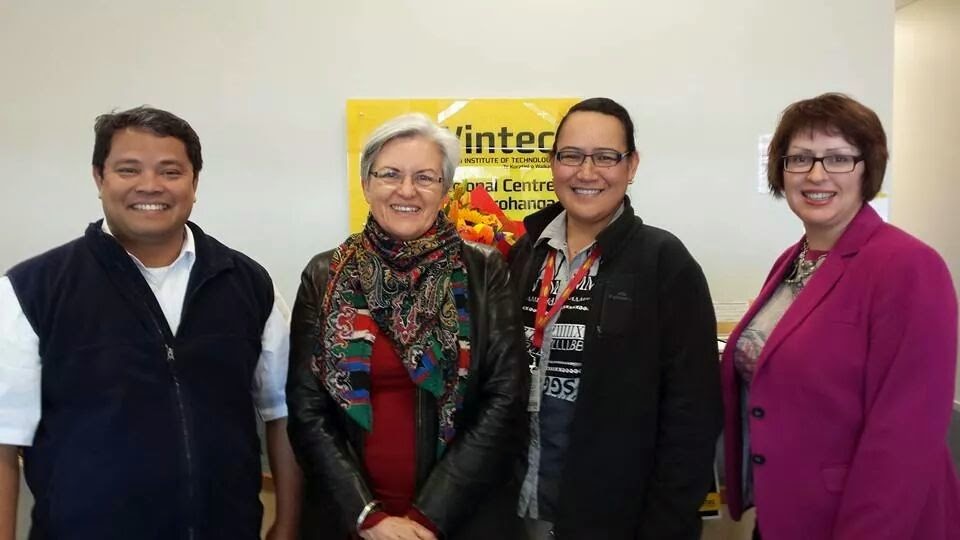
...and just this last week, on Monday, Maryan Street (List MP, candidate for Nelson, spokesperson for Tertiary Education and State Sector) came and visited Otorohanga's Wintec campus and spoke with Grey Power in Te Kuiti.
 
Maryan Street and Penny Gaylor with some Wintec staff in Otorohanga.
 
And the next day, David Shearer (Mt Albert MP and spokesperson for Foreign Affairs and Energy) and Chris Hipkins (Rimutaka MP and spokesperson for Education and Forestry) arrived in Te Awamutu and met with Penny Gaylor, the local Labour party faithful and Dean Taylor from the Te Awamutu Courier before heading down to Otorohanga for a tour of the Otorohanga Timber Company, a meeting with The Lines Company, dinner with more local Labour party faithful and a public meeting at the Otorohanga Rugby Club.
 
Chris Hipkins, Penny Gaylor and David Shearer outside of Churchills in Te Awamuti.

Steve Wilshier explaining how the OTC adds value to timber products before exporting them overseas and also supplying the New Zealand market.

Brent Norris (TLC CEO), David Shearer, Chris Hipkins and Penny Gaylor after a healthy discussion on electricity supply.

Penny Gaylor, David Shearer and Chris Hipkins taking questions from the audience at the public meeting at the Otorohanga Rugby Club.


People were very interested in the education policy that Labour had released the previous week, and were also very keen to hear about Labour's ideas in the energy portfolio, particularly to do with electricity.  Also discussed was the rehabilitation of offenders in prisons through teaching them to read, write and do maths; forestry exports and jobs; housing; tourism, railways/transport and dairying.
 
The next morning, David Shearer, Chris Hipkins and Penny Gaylor also attended a public meeting in Taumarunui and discussed similar issues before Chris and David visited the Wairakei geothermal electricity generation plant. 
 
I am also adding in here the Storify of my tweets and others who responded from the public meeting held by the Labour candidate for Taupo, Jamie Strange, at the Cambridge Primary School.  David Shearer, Chris Hipkins and Sue Moroney also spoke at this meeting and Hamilton East candidate Cliff Allen and Waikato candidate Christine Greer also attended the Cambridge meeting.  At this meeting electricity was especially the hot topic, but also issues on education, social welfare, homelessness, pollution of waterways and the minimum and living wages.


Next month Penny will be hosting Grant Robertson (Wellington Central MP, Shadow Leader of the House, spokesman for Economic Development and Employment, Skills and Training)  in Te Awamutu and Annette King in Inglewood and also hopes to have several other Labour MPs visit districts in the TKC electorate.
 
 
Labour is committed to encouraging growth and development in the regions.  They want jobs and businesses in the regions that add value to products such as wood (like at the Otorohanga Timber Company), dairy, meat, wool, and many other products before they are exported.  Go to most wharf facilities and you will see raw logs being loaded onto ships to China... and then watch it come back as building materials.  Why are we exporting raw product to have it processed overseas and then import it back in to New Zealand?
 
Just in the last year in Hamilton and out in the Waikato we have seen the closure of the Huttons factory with the loss of 125 jobs, 90 jobs cut from New Zealand Post, 93 jobs cut at the Huntly East Mine, 22 jobs gone from Genesis' Huntly Power Station and an unspecified number of jobs are to go from the Genesis Call Centre in Hamilton, Metso in Matamata closed down (due to the high dollar by the way) costing 30 jobs, Thames Timber cut 70 jobs and we know there will be job losses when the Waikato DHB shuts the maternity units in Morrinsville and Te Awamutu and if National gets back in and shuts down the Ruakura Research Centre. 
 
That's 340 jobs gone, plus the unspecified amount of jobs from the Call Centre, and the Maternity and Research Centre jobs yet to be given confirmation, in the Waikato alone since August 2013. 
 
That's another thing, why would you shut down a research centre that focuses on dairy research in the middle of the best dairy country in New Zealand and move them to Christchurch????
 
There are probably many other job losses that have not been so publicly recorded.
 
www.interest.co.nz has a page called Reported job losses which they are updating monthly from a variety of sources around the country.  At the end of 2013, the tally of job losses recorded on this page was 6,390, and at the time of publishing this blog in July 2014, the 2014 tally of job losses recorded was 2,669 - and July is not a closed book yet.
 
The website also has a page covering the Recession job-loss tally of late 2008-2009.  In November/December 2008, 4,486 jobs went nationwide, 594 in the Waikato alone (but there were others classed as nationwide that could include further job losses in the Waikato that have not been specified).  From January to August 2009, plus October, 18,699 jobs disappeared (a significant number were in the state sector), and 650 jobs were lost in the greater Waikato (plus additional ones classed a nationwide).  What is interesting when you look at both pages, both time periods, is the number of jobs gone in regional New Zealand is fairly significant. 
 
And it is significant to each and every one of those communities, because for every person who loses their job, there are people, families depending on that income that no longer will be getting that income.  It affects their communities because they no longer have that money to spend at the supermarket, the local book store, the corner dairy, for the sports club fees, the school fundraisers....
 
What many people in the regions forget is that the regions do well under Labour.  The Labour led government under Clark was good for the regions.  Unemployment went down.  Farmers prospered with the structure provided by Fonterra under Labour.  Horticulture and aquaculture expanded.  Research and development that benefitted the regions was encouraged.  When someone plans the economy, it allows and encourages development throughout the country.
 
As I drive down the street in Te Awamutu, there are a number of empty stores.  Then go further south in the Taranaki-King Country... there are pockets of inspiration, but still too many empty shops, closed down factories, mills and services.  Too many people for the jobs available, and many in poorly paid employment.
 
Under National's "hands off the steering wheel" policy, we've seen companies like Metso (which built large scale mining vehicles and crusher machines and the like which were exported all over the world) close down because the high dollar made their business unsustainable.  That was a long standing business in Matamata, (originally as Tidco, then as Svedala), around since sometime in the 1970s, which was hailed in 1988 by Mike Moore as an example of a New Zealand company as an exporter on the up and up.  Just about all my life I have known someone who works at this company, family and friends, which has now withdrawn from Matamata and New Zealand.
 
 
So it was great to visit a business like Otorohanga Timber Company with Penny and Chris last week that has an extremely strong commitment to their community (Steve is well known for supporting a good cause in Otorohanga), employing local staff year round as well as local students back in town for summer from university and tech, and even young rugby and cricket players from overseas in town for the season.  This business has had to adapt to the economy, but would probably do even better out of its exports if the New Zealand dollar wasn't so high.
 
 
While, obviously because I am a teacher, I am basing my voting choices on education primarily, I am also considering other factors.  Jobs is an important factor.  If there are great jobs for people in the regions then there will be children for me to teach.  If their parents are gainfully employed, earning a quality wage, then their kids are likely to be in a warm, dry house, fed and clothed, their health needs met, and ready to learn at school.  Employed people mean that a variety of businesses in the area flourish, also employing people.  And communities become vibrant because of the businesses that are well established support local sporting and community groups and also encourage new businesses to open.  And I love to shop, so a vibrant community is good for me!!
 
 
Like David Cunliffe said, this election is about people.  It is about their hopes and dreams.  It is about being valued and respected.  Having reliable, stable employment and being paid well for the job you do gives people hope. 
 
Labour wants to bring hope back to regional New Zealand.
 
To find out more about how Labour plans to do this, click here to go to the Labour policy on Regional Development.  It gives you a broad over view of the policies and the ability to download the detailed policy.
 
So if you are in the Taranaki-King Country electorate, get out and meet your candidates (all of them) and talk to them about the policies of their parties and find out about the people that have put themselves up as candidates for you to choose as your representative in Parliament.
 
And you never know... Taranaki-King Country could become a red electorate with Penny Gaylor as MP - you just have to get out and #votepositive #ForABetterNZ!