Tuesday, 22 July 2014

Election 2014: What Labour is doing in Taranaki-King Country.

As we head into the election, each political party is releasing policy, putting up hoardings, mobilising their volunteers (or paying circular deliveries if you are Colin Craig) to deliver pamphlets, and politicians are out kissing babies.

I live in the Taranaki-King Country electorate.  It's a dark blue electorate.  You could put a gorilla up as the National candidate and no one would bat an eye lid and vote it in as the National MP for Taranaki-King Country.

Shane Ardern has been the MP for Taranaki-King Country (TKC) since 1998.  The only thing he has ever done of great notice was drive a tractor up the steps of Parliament in 2003 to protest again the proposed "Fart Tax" that was being proposed to counter the greenhouse gases created when a cow farts.  It was a memorable stunt.

After that, however, nothing Shane Ardern has done is even worthy of putting in a Wikipedia site.

In fact, as a constituent, from September 2012 until April 2014 I tried to get Shane Ardern to meet with the Waipa Branch of NZEI, teachers and support staff, people who are his constituents.  He refused, point blank, to meet us.

So when he announced in early December 2013 that he would retire from politics at the 2014 election to spend more time with his family and on the farm, I was extremely pleased, ecstatic.  As it was my birthday that week I took it as a birthday present from the gods.

And Labour in TKC has been invigorated by the fact that there is no incumbent MP standing in the electorate. 

Late last year the call went out for a meeting to be held, and in late February a meeting was held, potential candidates put up their hands, and in late March a candidate was selected by ballot.  Penny Gaylor, a district councillor from Otaki on the Kapiti Council and active Labour party member, was voted as the candidate.  Then a Labour Electorate Committee (LEC) was formed in April, those members attended the Region 3 List Selection Day in May, and by June the campaign was in full force.

Penny Gaylor after the votes were counted for who would be the Labour candidate for Taranaki-King Country in the 2014 election.
The LEC has been very active in getting Penny Gaylor's name out in the community and she has been spending considerable time visiting people and organisations in Te Awamutu, Raglan, Kawhia, Otorohanga, Te Kuiti and Inglewood.  She has also attended events in New Plymouth with Andrew Little and attended a meeting in Taumarunui recently in order to raise the profile of Labour and the party policies as well as making herself known in the TKC electorate and beyond.

Some time in May we vaguely heard of a candidate for National being selected.  A farmer, female.  And then we heard of a Green candidate.  And then earlier this month a candidate from the Internet-Mana party.  So currently we know of four candidates duking it out for TKC.
 
Penny has been supported by some senior MPs in getting the Labour campaign started and promoting local issues that Labour is strongly concerned about.  One of the first MPs to visit was Annette King (Rongotai MP and Health spokesperson) along with List MP Sue Moroney (Chief Whip, Hamilton West candidate and Social Development spokesperson).  That day they visited a local kindy in Te Awamutu, Plunket and discussed the impact of the Matariki birthing unit being closed by the DHB with midwives and other community members.


Annette King, Penny Gaylor and Sue Moroney discussing issues at the Plunket rooms with parents, community leaders and health professionals of Te Awamutu.

Penny has also be actively visiting people in a number of communities, door knocking and has also done some phone canvasing.


Penny has visited Raglan Area School and other businesses in Raglan with List MP Moana Mackay (Environment, Climate Change and Science spokesperson) and Waikato-Hauraki MP Nanaia Mahuta (Maori Affairs and Treaty of Waitangi spokesperson) in May....
 
Penny Gaylor and Nanaia Mahuta and the team at the recycling company they visited.

Nanaia Mahuta, Moana Mackay and Penny at Raglan Harbour.
 
...she has done some canvasing and door knocking in Stratford with Whanganui candidate Hamish McDuall....
 
Penny Gaylor and Hamish McDuall in Stratford.
 
 
....attended the Fieldays with David Cunliffe (Labour leader, New Lynn MP and spokesperson for Regional Development and the SIS), Sue Moroney and Cliff Allen (Hamilton East candidate) on the Thursday and again on the Friday with Damien O'Connor (West Coast MP and Primary Industries, Fisheries, Food Safety and Biosecurity spokesman) and Cliff Allen....
 
David Cunliffe helps Penny out with some "adverstising".

Sue Moroney, David Cunliffe and Penny Gaylor with some Rhode Street School students at the Fieldays.
 
....a meeting (among others) with young people strongly involved in politics in New Plymouth with Andrew Little (List MP, candidate for New Plymouth and Justice and Labour spokesperson)...
 
Andrew Little and Penny Gaylor at the Youth in Politics meeting in New Plymouth.
 
...and just this last week, on Monday, Maryan Street (List MP, candidate for Nelson, spokesperson for Tertiary Education and State Sector) came and visited Otorohanga's Wintec campus and spoke with Grey Power in Te Kuiti.
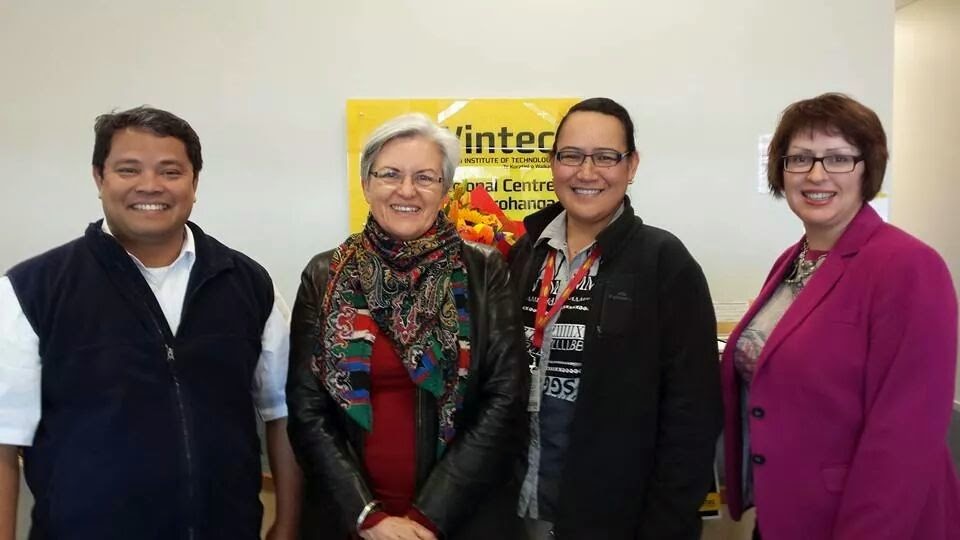
 
Maryan Street and Penny Gaylor with some Wintec staff in Otorohanga.
 
And the next day, David Shearer (Mt Albert MP and spokesperson for Foreign Affairs and Energy) and Chris Hipkins (Rimutaka MP and spokesperson for Education and Forestry) arrived in Te Awamutu and met with Penny Gaylor, the local Labour party faithful and Dean Taylor from the Te Awamutu Courier before heading down to Otorohanga for a tour of the Otorohanga Timber Company, a meeting with The Lines Company, dinner with more local Labour party faithful and a public meeting at the Otorohanga Rugby Club.
 
Chris Hipkins, Penny Gaylor and David Shearer outside of Churchills in Te Awamuti.

Steve Wilshier explaining how the OTC adds value to timber products before exporting them overseas and also supplying the New Zealand market.

Brent Norris (TLC CEO), David Shearer, Chris Hipkins and Penny Gaylor after a healthy discussion on electricity supply.

Penny Gaylor, David Shearer and Chris Hipkins taking questions from the audience at the public meeting at the Otorohanga Rugby Club.


People were very interested in the education policy that Labour had released the previous week, and were also very keen to hear about Labour's ideas in the energy portfolio, particularly to do with electricity.  Also discussed was the rehabilitation of offenders in prisons through teaching them to read, write and do maths; forestry exports and jobs; housing; tourism, railways/transport and dairying.
 
The next morning, David Shearer, Chris Hipkins and Penny Gaylor also attended a public meeting in Taumarunui and discussed similar issues before Chris and David visited the Wairakei geothermal electricity generation plant. 
 
I am also adding in here the Storify of my tweets and others who responded from the public meeting held by the Labour candidate for Taupo, Jamie Strange, at the Cambridge Primary School.  David Shearer, Chris Hipkins and Sue Moroney also spoke at this meeting and Hamilton East candidate Cliff Allen and Waikato candidate Christine Greer also attended the Cambridge meeting.  At this meeting electricity was especially the hot topic, but also issues on education, social welfare, homelessness, pollution of waterways and the minimum and living wages.


Next month Penny will be hosting Grant Robertson (Wellington Central MP, Shadow Leader of the House, spokesman for Economic Development and Employment, Skills and Training)  in Te Awamutu and Annette King in Inglewood and also hopes to have several other Labour MPs visit districts in the TKC electorate.
 
 
Labour is committed to encouraging growth and development in the regions.  They want jobs and businesses in the regions that add value to products such as wood (like at the Otorohanga Timber Company), dairy, meat, wool, and many other products before they are exported.  Go to most wharf facilities and you will see raw logs being loaded onto ships to China... and then watch it come back as building materials.  Why are we exporting raw product to have it processed overseas and then import it back in to New Zealand?
 
Just in the last year in Hamilton and out in the Waikato we have seen the closure of the Huttons factory with the loss of 125 jobs, 90 jobs cut from New Zealand Post, 93 jobs cut at the Huntly East Mine, 22 jobs gone from Genesis' Huntly Power Station and an unspecified number of jobs are to go from the Genesis Call Centre in Hamilton, Metso in Matamata closed down (due to the high dollar by the way) costing 30 jobs, Thames Timber cut 70 jobs and we know there will be job losses when the Waikato DHB shuts the maternity units in Morrinsville and Te Awamutu and if National gets back in and shuts down the Ruakura Research Centre. 
 
That's 340 jobs gone, plus the unspecified amount of jobs from the Call Centre, and the Maternity and Research Centre jobs yet to be given confirmation, in the Waikato alone since August 2013. 
 
That's another thing, why would you shut down a research centre that focuses on dairy research in the middle of the best dairy country in New Zealand and move them to Christchurch????
 
There are probably many other job losses that have not been so publicly recorded.
 
www.interest.co.nz has a page called Reported job losses which they are updating monthly from a variety of sources around the country.  At the end of 2013, the tally of job losses recorded on this page was 6,390, and at the time of publishing this blog in July 2014, the 2014 tally of job losses recorded was 2,669 - and July is not a closed book yet.
 
The website also has a page covering the Recession job-loss tally of late 2008-2009.  In November/December 2008, 4,486 jobs went nationwide, 594 in the Waikato alone (but there were others classed as nationwide that could include further job losses in the Waikato that have not been specified).  From January to August 2009, plus October, 18,699 jobs disappeared (a significant number were in the state sector), and 650 jobs were lost in the greater Waikato (plus additional ones classed a nationwide).  What is interesting when you look at both pages, both time periods, is the number of jobs gone in regional New Zealand is fairly significant. 
 
And it is significant to each and every one of those communities, because for every person who loses their job, there are people, families depending on that income that no longer will be getting that income.  It affects their communities because they no longer have that money to spend at the supermarket, the local book store, the corner dairy, for the sports club fees, the school fundraisers....
 
What many people in the regions forget is that the regions do well under Labour.  The Labour led government under Clark was good for the regions.  Unemployment went down.  Farmers prospered with the structure provided by Fonterra under Labour.  Horticulture and aquaculture expanded.  Research and development that benefitted the regions was encouraged.  When someone plans the economy, it allows and encourages development throughout the country.
 
As I drive down the street in Te Awamutu, there are a number of empty stores.  Then go further south in the Taranaki-King Country... there are pockets of inspiration, but still too many empty shops, closed down factories, mills and services.  Too many people for the jobs available, and many in poorly paid employment.
 
Under National's "hands off the steering wheel" policy, we've seen companies like Metso (which built large scale mining vehicles and crusher machines and the like which were exported all over the world) close down because the high dollar made their business unsustainable.  That was a long standing business in Matamata, (originally as Tidco, then as Svedala), around since sometime in the 1970s, which was hailed in 1988 by Mike Moore as an example of a New Zealand company as an exporter on the up and up.  Just about all my life I have known someone who works at this company, family and friends, which has now withdrawn from Matamata and New Zealand.
 
 
So it was great to visit a business like Otorohanga Timber Company with Penny and Chris last week that has an extremely strong commitment to their community (Steve is well known for supporting a good cause in Otorohanga), employing local staff year round as well as local students back in town for summer from university and tech, and even young rugby and cricket players from overseas in town for the season.  This business has had to adapt to the economy, but would probably do even better out of its exports if the New Zealand dollar wasn't so high.
 
 
While, obviously because I am a teacher, I am basing my voting choices on education primarily, I am also considering other factors.  Jobs is an important factor.  If there are great jobs for people in the regions then there will be children for me to teach.  If their parents are gainfully employed, earning a quality wage, then their kids are likely to be in a warm, dry house, fed and clothed, their health needs met, and ready to learn at school.  Employed people mean that a variety of businesses in the area flourish, also employing people.  And communities become vibrant because of the businesses that are well established support local sporting and community groups and also encourage new businesses to open.  And I love to shop, so a vibrant community is good for me!!
 
 
Like David Cunliffe said, this election is about people.  It is about their hopes and dreams.  It is about being valued and respected.  Having reliable, stable employment and being paid well for the job you do gives people hope. 
 
Labour wants to bring hope back to regional New Zealand.
 
To find out more about how Labour plans to do this, click here to go to the Labour policy on Regional Development.  It gives you a broad over view of the policies and the ability to download the detailed policy.
 
So if you are in the Taranaki-King Country electorate, get out and meet your candidates (all of them) and talk to them about the policies of their parties and find out about the people that have put themselves up as candidates for you to choose as your representative in Parliament.
 
And you never know... Taranaki-King Country could become a red electorate with Penny Gaylor as MP - you just have to get out and #votepositive #ForABetterNZ!

Saturday, 12 July 2014

Labour's Education Policy - An antidote to the GERM infection of the last six years.

The first weekend of July saw the Labour Party well and truly launch its 2014 election campaign.  They had a three day Congress in Wellington, and I attended the Sunday when David Cunliffe made his keynote speech and laid out the bones of some very important policy Labour wants to base its campaign on.  And education was at the core of it.

I was very far away from the middle, coughing my germs I had to the empty space on the edge of the auditorium, hence this terrible photograph I took.

As a teacher, any announcements on education are of great interest to me, particularly if they are going to get rid of what I think is detrimental in education (GERM policies, National Standards, Charter Schools, performance pay, IES roles, no teacher representation on EDUCANZ) and will promote and/or improve what teachers know to be valuable in education (teacher education pre-service and for those in practice, special education, class sizes, work load, New Zealand Curriculum, and so on).

I was not disappointed.

But please do not think that I am merely basing who I will vote for on education.  Education will be the first thing I think about though because I work in it, I'm passionate for learning and children, and it pays for the important things I do like eating and shopping and the internet - the priorities in life.

However, I do also consider other things like the following:

  • the economy - will they balance the books and be responsible?
  • employment - will their policies create jobs or put people out of jobs?  Will they make it fairer to the employee so they have job security?  Will the Living Wage happen so that we don't have the working poor living in poverty?
  • housing - will I be able to buy a house before I truly get wrinkles?  Will rental houses be warm and dry and healthy?  Will all those families living in cars and garages get a state house?
  • environment - will they improve the health of our waterways so I can swim in the Waikato and Waihou Rivers with confidence?  Will the kauri survive the kauri die back disease?  Will our native birds be protected?  Will 1080 be used in the bush?  Will the Maui dolphin be protected?  Will oil drilling and fracking be placed under much tougher regulations?
  • Christchurch - will those poor people get a fair deal from their insurance companies?  Will the rebuild meet what a modern city should/could be?
  • manufacturing - will there will be manufacturing in New Zealand?  Will people be encouraged to invest in improving our primary goods (e.g. milk, wood, wool, etc) before exporting rather than sending off the raw product?
  • the regions - will the people of the regions be able to stay and have a good standard of living with a job close to home, or will they have to move to Auckland?
  • health - will they make the waiting list process more transparent rather than the lie it currently is?  Will more people get their operations sooner so they can become productive members of society again?  Will more get put into addiction services?  Will nurses get paid better and get more nurses in wards to reduce their workload and improve patient care?  Will care in our rest homes be upgraded for the elderly?
  • welfare - will we see children of beneficiaries taken care of?  Will solo parents get a fair shake of the stick when it comes to improving their education and work prospects?  Will WINZ go back to having caseworkers who know what's going on with each client so they don't waste time?
  • TPPA - will they give away our rights and freedoms to run our lives and our country free from foreign companies dictating what should happen in New Zealand?
So as you can see, I have a few issues to consider.  They may not be the same as yours, or we may have some in common, but it is our responsibility as voters in a democracy to consider who we will vote for and why.

So on Sunday as I listened to David Cunliffe's speech (you can watch his speech here, along with other speeches from other Labour MPs), I did have cause to be happy about a number of things.  Consequently I tweeted and retweeted things, and then I put it all together with Storify (please excuse the places where my fingers and the smartphone disagreed on what letter I pushed).  So here is what I heard and saw:


You can now see why I was a happy teacher.  And now I want to go and look more in depth at the education policy.


Early Childhood Education and Families:

You may remember back in the end of January David Cunliffe did his own State of the Nation speech and he announced some key policy for families and pre-schoolers, the Best Start for Our Kids policy:
  • All families earning under $150,000 per year will receive $60 per week for a baby’s first year of life. For parents who are eligible for paid parental leave, the payment will kick in once this comes to an end. Low and modest income families will also receive $60 per week between the child’s first and third birthdays.
  • Free early childhood education for three, four and five year old children will be extended from 20 to 25 hours a week
  • Paid parental leave will be extended from 14 to 26 weeks as set out in Sue Moroney’s Member’s Bill.
  • Free antenatal classes for all parents who want them and extra visits from organisations like Plunket for those who need it most.

This caught people's attention and the paid parental leave bill promoted by Sue Moroney is a particularly popular policy.  This bill has received support across the House - except from National who want to veto it and put up their own half-baked 18 week scheme in Budget 2014.  Hopefully after 20 September, Sue's Bill will be passed and enacted.

Labour will also do the following for pre-schoolers:
  • From July 2017 (the tenth anniversary of 20 Hours Free), Labour will extend the Free ECE policy to 25 hours for three and four year old children. The policy will also apply to those five year olds still in early childhood education services. (Extending Free ECE to 25 Hours)
  • Labour will restore over time National’s funding for highly qualified ECE centres. We will work with the sector to reinstate the policy of 100 percent qualified staff in all teacher-led services.  The first phase of restoring funding for 100 percent qualified ECEC centres will be provided in Labour’s first Budget in 2015 and come into effect from January 2016.
  • We will build more ECE centres in high-need areas so there are enough places for kids who need them.
And Labour has committed to the following by establishing a Ministry for Children:
  • We will do away with the Families Commission and focus funding on an independent Children’s Commissioner.
  • We will also implement a plan to measure and set targets to reduce child poverty that would be backed up by legislation, and report on progress every budget.
These are important steps in the early years.  For every $1 spent on children in the first five years of their lives, we save $11 later on for each child.  Getting in early saves money and creates a healthier individual in all ways as a citizen, and a healthier community.  I think that it is important that ECE services are teacher led and employ fully trained and registered teachers who understand how young children develop and to ensure their learning needs are meet alongside the growth of their social skills and physical development.

Schools - Years 0-13:

Now this was the part that was especially important to me, being a teacher of primary aged students.

Labour will back quality education and invest in 21st Century Schools by:
  • Hire 2,000 more teachers
  • Reduce the average size of secondary school classes from 26+ down to 23.
  • Reduce the size of senior primary school classes (Years 4-8) from 29+ down to 26.
  • Invest $104 million in new classrooms.
  • Support professional development for our teachers.
  • Put in place a programme that provides an affordable option, available to all schools, for Year 5-13 students to have access to a portable digital device, in the classroom and at home.
  • Commit $25 million to provide teachers with professional development during the 2016 and 2017 school years to assist them to make the most effective use of digital devices in the classroom.
  • Partner with schools, local government and communities to put in place infrastructure that will allow students, particularly those from low-decile schools, who do not currently have internet connections to use their portable devices to access the internet at home.
  • Develop a comprehensive plan for rebuilding out-dated and worn-out school buildings, so that every school has access to modern learning environments by 2030.
So far so good.  Every teacher will tell you that a few less kids in their class means more time for the remaining students, a relief from some paperwork those few more kids create.  It can mean the difference between teaching and crowd control.  And when you consider how big a 12 year old is, a few less bodies in the room creates space.


Teachers have been left in the wilderness since the Advisory Services were dismantled in 2009.  Professional Development for many teachers became a distant memory as the new arrangement has often been too expensive, so only selected people get to attend PD courses.  Also, it means that if you have a weakness in science, there were no advisors to come and advise you anymore.  Consequently teachers and principals are welcoming the long waited proposed return of the Advisory Service so schools can again access quality advice and cost-effective PD.

A digital device for all Year 5-13 students is music to my ears, probably because it would make what I want to do as a teacher who loves teaching digitally more of a reality in more schools.  It is good that Labour are also planning on backing this with PD for teachers (because plenty will need it) and internet access in the home.  The internet access solution will be interesting to put into practise as I can see there may be many pitfalls to overcome and it won't happen overnight.

And just this weekend I was with a friend who teaches in a decile one school in Porirua.  She told me her classroom was straight out of the 70s.  So an upgrade of her and her student's working/learning conditions is desperately in need.

Labour will also:
  • Fund schools $100 per student per year if they don’t demand donations from parents.
  • Scrap National Standards and return schools’ focus back to teaching the full breadth of New Zealand’s internationally acclaimed curriculum.
  • Require schools to report student progress to parents in all areas of their learning.
  • Ensure every child develops the basic foundations for further learning by extending Reading Recovery so kids falling behind can catch-up.
  • Re-direct resources spent forcing ‘National Standards’ on schools into teacher professional development programmes to assist students who are underachieving.
  • We will repeal charter school legislation and no more charter schools will be created under Labour. 
Donations have always been a bone of contention, and I can see many schools will be winning with this piece of policy.  I can see how schools like Auckland Boys' Grammar and the like will not be keen on this policy, but parents will like it.  For many schools the funding created by the donations system is the difference between having sports gear for the kids at lunch time to play with or not having any sports gear at lunch time; the difference between having a digital camera in each syndicate or not having a digital camera at all; the difference between having a school production or not having a school production.  Different schools rely on that money for many things that the Ops Grant does not pay for.
 
You many have noticed that I have bolded and highlighted in red two very important policies: getting rid of National Standards and Charter Schools.  These represent the cornerstone of GERM philosophy, of creating a crisis in education and then privatising our quality public education system.  Prior to National enacting National Standards, New Zealand was ranked in the top five of the questionable PISA rankings.  Since National Standards were introduced we have slid down the ranks.  Infact each country which has introduced policies like National Standards (i.e. Common Core in the US, Naplan in Australia, Key Stage Testing in the UK) and consequently Charter Schools, have slid down the international rankings in more that just PISA. 
 
Labour will require teachers to focus on our world leading and much acclaimed New Zealand Curriculum, on all learning areas, and to report to parents on all the learning areas.  This is great for children, because it means we can celebrate those children who also excel in art, physical education, science, music, drama, dance.... not just reading, writing and maths.
 
And I am really pleased to see that Reading Recovery will get a boost and that the National Standards budget will be redirected to help those kids that don't receive ORS funding but need extra help.  Reading Recovery funding has been tightly squeezed each year, and definitely there was less money for the end of 2012.  The earlier we can get in and help students with their learning, the sooner they will be able to become independent and confident learners.  One way the Professional Development could help is teaching teachers how to recognise dyslexia and help children with dyslexia overcome the obstacles that dyslexia likes to create.
 
"Every week 40,000 kids turn up to school without breakfast or without lunch and are fed by charities. But there a more kids who need help. The last nationwide survey of children’s nutrition undertaken by the Ministry of Health found 83,000 children aged 5 to 14, sometimes or often went to school without breakfast.
"Labour will partner with community and voluntary organisations, incorporating the most cost-effective approaches currently operating, to provide free food in every decile 1-3 primary, intermediate school that needs and wants it."

There are schools that see kids turning up day after day without having had breakfast and a poor lunch if any.  I recently read of a teacher who brings bread, butter and spreads to school to feed the kids without lunch - until her principal told her to stop doing it (so she had to get sneakier at feeding these kids).  I have a friend who teaches at a decile 6 high school.  She has a toaster, bread, butter, spreads, jug, milk and milo ready for any kid who needs it in her class.  And it is well used, and she gets better work out of the kids who ate than the kids who came hungry and did not use the food and facilities she provided.
 
Tertiary Education:
 
"The National Party is removing the right of students, staff and other community groups to be represented on university councils. It follows the Government’s introduction of voluntary student association membership and is a further silencing of students.
"Labour is making a commitment to students that when we are elected to government we will ensure they are represented on university councils and have strong student associations.
"We believe having those who are involved in learning and teaching on the governing bodies of universities is a good thing and adds value to the decisions being made."

This is not a good move for universities as it takes their accountability to students, staff and the community away.

There will be more tertiary education policy announced in the lead up to the election.
 

Adult Education:

Labour has committed to reinstating adult education:
  • Restore $13m per year for Adult and Community Education
  • Another $9m per year on top of that from 2018
  • $1m per year of extra funding for ACE English for speakers of other languages (ESOL)

"It’s a cornerstone of New Zealand communities and offers pathways for New Zealanders looking to retrain and reengage with education, and for new New Zealanders to gain the skills and community connections to grow and establish their new lives in New Zealand.  Labour recognises that a lot has changed since the National Government cut ACE funding, which is why the allocation of this funding will be made in close consultation with the adult education sector. We believe that to get the best results for all New Zealanders who want to access ACE we need to work alongside the sector."

I think that reinstating Adult Community Education is a win:win.  It was a conduit for people to get skills and further their education.  But not just for those people, I have taken my fair share of night classes: te reo Maori (excellent for increasing my te reo use in the classroom) and Spanish (I had two Uruguayan students whose English wasn't flash, and learning Spanish helped build my relationship with them and understand their frustrations).

These are the policies that have been released so far to do with education at the time of publishing this post (14/07/14).

I personally am pleased with the direction Labour is taking with education.  It is clear that it has consulted and actually listened to stakeholders and intends on being collaborative in the true sense once it takes over the government benches (fingers crossed) in late September.

I think Labour is meeting the standard when it comes to education policy.  I will endeavour to update when future education policy is released, and when Labour becomes the lead partner in government I will be reminding them of their policy promises and monitoring their follow through.

Kids at the Heart of Education Nationwide Tour - Hamilton Public Library

I think that it is pretty much not a secret that I am in no way of fan of this National led government and the choices they have made and the policies they have followed.  Some of you may have detected a rather obvious leaning towards Labour.  However, they too do not have all of the answers. 

I've always liked the Greens in some areas because they have a real social conscious and a lot of what they talk about when it comes to the environment makes sense.  I've been disappointed that during Helen Clark's time as Prime Minister with Labour the Greens were not inside the tent, but I respect their reasons for why and why not.

But I think 2014 is the year that the Greens and Labour can work it out.  They have a lot they agree on.  I think they have lots of areas they can work together and compromise on either side on.  I think there will be some big areas where they may have to agree to disagree, but I think, on the whole, these two parties have the talent, expertise and determination to form a very effective government with a social conscious.

I've seen Catherine Delahunty speak previously at NZEI's Annual Meetings and I love her enthusiasm.  She and Metiria Turei have been vocal in their opposition to National Standards, Charter Schools and the GERM infestation of our education system, so I was excited to hear they were doing a tour of the country to discuss education and their policy of Schools as Community Hubs.  I was even more excited to know Professor Martin Thrupp, a leading academic on education from the University of Waikato, would also be speaking.


As a teacher I am stoked to know that the Green Party would not have performance pay for teachers, can National Standards and Charter Schools, and reinstate our quality public education system to be the best it can be.

Martin Thrupp was very clear that our quality public education system is on the precipice.  This election will either be the death of it under a third term National led government, or it will be saved by a government from the Left.

Below is the Storify of the tweets I tweeted and received that night (by the way, I apologise for my fingers and the smartphone keyboard not always agreeing on the letter I actually wanted to type):


Reflecting back on this evening, I remember thinking that Catherine and Metiria really understand how important the school is in every community, that it is not just about the relationships teachers have with the children, but with the families and extended families - and the actual school itself as a focal point for all.

I have mostly taught in rural schools, where the school really is the focal point.  It disseminates the news for all the community - when tennis is starting, when the Anzac service is, when the community church will have a service, when the local clay bird shoot competition is, when the rugby muster is, what's happening at the play centre and so on.  It means that not only the families with students at school are in the know, but the wider community also knows.

And that is the beauty of the Schools as Community Hubs - it draws the community together even more.  By bringing early childhood services, health and social services onto the school site, a tighter community unit can be established earlier on.  The idea of it takes a village to raise a child will be reinstated in the public consciousness.

Victory School in Nelson have been doing this concept for a decade already.  They are in a low socio economic area, but have seen community relationships build, family health improve and educational outcomes exceed schools with similar demographics.

Metiria said that each school community would have to mould what they wanted their Hub to look like, that you just can not take the Victory model and implant it as the solution for each and every community.  The Hubs are all about making local solutions for local challenges.

The election on the 20 of September is an important election.  It is a choice we all have to make as voters about whether or not we want to continue with National's no social consciousness or do we want to make New Zealand the fair and better society we aspire for our children of now and the future.

Sunday, 25 May 2014

Teacher Battery Life.... Job Satisfaction.... Teacher Wellbeing.

Very early on Sunday morning, I posted this pic on Twitter after a fun night out with a couple of other teachers blowing off a bit of steam:


I posted it because that's pretty much how I feel every Friday night.  I am exhausted.  Why?

When I was a young teacher, probably about three or four years into it, my then principal, Bob Marlow, said that if you weren't shattered every Friday night you hadn't done your job properly.  A full on week would be full of all the things that teachers do:  maths, reading, writing, art, topic studies, PE, music, drama.... being creative and inspirational.

It seems though that in the last few years things have changed.  The government policies have been invaded with GERM, the expectations of parents have been inflamed by government propaganda on 'the crisis in education', teachers just keep adding more to their responsibilities, management focus on data and improved student outcomes, higher recognition of societies woes such as poverty and inequity.... 

All of this compounds on teacher workload, job satisfaction and wellbeing.  Work/life balance for many teachers is now seriously out of balance, and this is having a detrimental affect on their physical and mental health, and impacts on how schools run and children learn as a result.

I started working with Bob in my third year of teaching in 1997 (showing my age here) when the New Zealand Curriculum Documents were well into the full swing of being drafted, released, consulted, refined, issued, implemented.  It was busy.  We were getting our heads around eight curriculum areas all having fat documents with Strands and Achievement Objectives and examples of learning at a number of defined curriculum levels.  It all brought a new level of accountability to the education of children and the teaching profession.

But teachers were still free enough to be creative and innovative.  We did lots of extremely fun stuff, worked hard and learned lots.  But Bob still had us assessing the children regularly and every term we all focused on the one strand and produced a school wide snap shot of learning and assessment in that strand of the Curriculum.  Back then, despite being shattered on a Friday night, I'd push through and go out with my mates for a night out on a Friday, until it was netball/rugby season and Saturday night was the night out.

By the mid-2000s there was another Curriculum review, and a new draft Curriculum appeared in 2007.  We consulted, trialled, researched and commented and by the beginning of 2009 we were at full implementation stage.

However, this was high-jacked by GERM and the new National-led governments introduction of National Standards in reading, writing and mathematics.  The attention went off fully implementing and learning the new Curriculum Document (mercifully in one book instead of the previous eight separate books) and on to figuring out how National Standards work, how to assess them, how to make them meaningful considering they were not researched, trialled or based on how we knew children learned - unlike the Curriculum.

Any experienced teacher would tell you that they have always worked hard, but the climate of teaching changed in 2009.  Teacher bashing became a sport in New Zealand thanks to the new government's mantra that teachers were failing their students and we had a big tail of underachievement.... all GERM mantras. 

In the last five years I have seen and heard of teachers crumbling under the pressure of the workload.  They mourn the loss of creativity and innovation because senior management is obsessed with data and improving student outcomes.  There are still pockets of innovation and creativity out there, but slowly GERM is strangling the life out of those insurgents who resist the data hungry beaureaucrats.  

This weekend I visited a school where a teacher had recently resigned.  She had resigned because she had high standards for herself as a teacher.  But under the current climate of what teachers are expected to do, she found she wasn't meeting her own standards in the job anymore.  She physically and mentally couldn't sustain the workload, and is now looking to work outside of teaching.

Teachers have absorbed more and more into their workload as the years have progressed.  We do it because that is the nature of the job, and people who go into teaching have that nature.  But when is enough enough?  When do teachers say:  "Hey, that's enough, I physically and mentally can not do anymore that what I'm currently doing, but hey, even that is a tad too much?"  When do teachers finally stand up and say the wellbeing of themselves and their family really does have to come before the job - because ,ask any teacher's loved ones, and they will all say the teacher in their family puts the job before them way too much.

As teachers we have always said the job is never done, there is always something else to plan, make, assess, sort, file, find..... but I have reached a point in my career where I know I can't do everything, and sometimes I have to fake it until I make it

And this pic I tweeted did cause a little response.  I did a Storify to present it in this blog post:


@66_pixie put the challenge out to me first that the picture I had posted represented teacher burnout, followed by @traintheteacher on how the "Superhero narrative needs to stop".

I've pushed myself the last few weeks.  There was lots going on.  I won't bore you with it all, but the important stuff was for the kids - assessing where they are currently at; getting baseline data for the four new students in my room; marking and collating the data; parent-teacher interviews.... there have been some late nights, two in which I was at school till 7:00pm and another until 8:00pm, plus some early wake up calls to get stuff done before I went to school.

I was shattered on Friday.  I came home (from an NZEI meeting - see, Friday night, dedicated to my profession) about 8:00pm and died quietly in the chair.  At about 9:00ish I went to my room, fluffed about, then decided I could accomplish nothing and was in bed not long after 10:00pm just cruising through Facebook and Twitter (discussing statistics on politicians using Twitter with some Masters student from Putaruru - and I thought his life was sad on a Friday night!) and the news because that was all my brain could cope with.  Put that on top of the Saturday night the other week when I slept through two Super 15 games in front of the telly before deciding bed is really where I should be.

Now, with the workload that it is, I think twice about going out on a Friday night, or any night.  I did the other week.  I went to a fantastic musical that a lot of people I know were in.  But I struggled not to yawn by intermission.  My body was stuffed.

But spending time with friends and family is important.  It is what makes me a better me and means I'm not always talking work stories - sometimes I have "I got up to mischief" stories!!  That's why the other Friday I went to the musical despite the fact I was bone tired, and why I went out for a blow out night with my teacher friends on Saturday.

Then as I cruised through Facebook after I finally woke up late Sunday morning (gee, I needed that sleep), I saw a post that a teacher friend, Kathryn, had posted.  I worked with Kathryn, a teacher from the UK, in 2009 in a large area school here in New Zealand.  She has since returned to teaching in the UK, and this was a post doing the rounds over there addressed to Michael Gove, the British Secretary of Education.  I reposted it on Save Our Schools NZ, saying it could be re-addressed to Hekia Parata.

Dear Mr Gove,

I am writing to thank you for teaching me so much about education. I have been a primary school teacher for 14 years and have always worked in challenging, inner city schools with many children who have complex behavioural and emotional needs. According to my performance management, I am an ‘outstanding’ teacher. I feel that over the last few years my skills have diversified conside...rably.

I am proud to be able to say that each year my pupils’ achievement and attainment have improved. I have become skilled at pinpointing what they need to learn and prioritising their experiences to ensure they succeed in the core subjects. Sacrifices have had to be made but, despite what they would like you to believe, there is not a single pupil who has not wanted to achieve and be successful.

The last few years in particular, my job has become even more varied. As we no longer have any external support and advice to help us, we have learned ‘on the job’ how to be councillors, behaviour specialists, social workers and mental health workers. We use our instincts when dealing with children with complex emotional and behavioural needs. We do everything we can, but you never can tell without the training. Hopefully those children experiencing extreme difficulties will pick up how to become good citizens and be able to live within, and contribute to, the community. I can only hope that they will know how to create a supportive and nurturing environment for their own children to succeed in the future. Maybe they will feel confident and proud of their achievements despite the lack of professional, quality specialists available to support their own complex needs in their formative years.

Until recently, I was not adept at data analysis. I now know that the pupils we are teaching are not simply children, they are numbers, percentages. The hours I have spent analysing data to decide which children need intensive afternoon intervention groups, those who need that extra ‘boost.’ Those children do not take part in the afternoon history, geography, art, science, music, PE or RE lessons as they are struggling with maths, reading and writing. They understand that they must miss out on subjects they are more likely to engage with, feel confident in, so they have the opportunity to achieve the required level in writing, reading and maths. They spend all day, every day struggling. Slowly feeling more and more like a failure, becoming more and more disengaged.

It is amazing that every one of my pupils knows what level they are working at and what level they need to be at the end of the year. Children are so desperate to achieve and to please others that they naturally put themselves under a huge amount of pressure. If they are not working at age related expectations they believe they are not doing well despite the amazing progress they have made. They are in tears. They feel the pressure. They know they are not where they ‘should’ be. They know already, at primary school, that they may not be ‘successful’ in the future. They know that the only subjects worth anything are reading, writing and maths. They know that their options are limited.

A big part of teaching is, and always has been, acting. You draw your audience in; encourage them to take part and to be inspired, challenged and enthusiastic about what they are discovering. There is nothing better than a class full of buzzing pupils, excited about what they are learning, taking ownership of the lesson. This is becoming increasingly hard to achieve when we expect so much from them. There is little time to have fun, to enquire, to be intrigued, to be children. They have too much pressure. They must, “compete with the world’s best.”

Why are we not letting them grow as individuals? Why are we damaging their self-esteem and confidence by trying to make them all fit into the same box? To ensure a successful future for our country we need to give children a broad, balanced curriculum which enables everyone to excel at what they are good at. They need to feel empowered and valued for their individual skills to be able to take risks and push the boundaries to be successful. How is that possible if they have had a restricted education? How will all those talented people who are not necessarily ‘academic’ excel in their different industries if they were not given the opportunity to hone their skills throughout their education? How will this improve our country? What sort of adults will they turn in to? I know I never had those pressures when I was a child.

I handed my notice in last week. I can’t do this to them anymore.

I asked Kathryn to comment about the two education systems of NZ and the UK now she'd been back in the UK system for nearly two years.  She responded that her thoughts were not for public consumption.

But this letter to Mr Gove has struck a chord here on SOSNZ's Facebook page with these comments on the post:

How sad.
What a loss to the teaching profession and learners in the UK.
I thought it was written by an NZ teacher also.

 NZ is copying things that have been shown to fail in the UK and the US

what a crying shame.. and sadly, this is our children's experience in nz too x

As I sit here writing reports based on National Standards data I do not know how much longer I can continue 'playing this game'. I am not being true to myself and this is not what I set out to do.

Well written. I to handed in my notice last week, for the same reasons. I cannot understand, no matter how much teacher's express the above concerns it is still happening. I feel more like an administrator than a teacher, specialising in data entry, has become the norm.

So true, very sad, well written!

The future of our children looks bleak

This is exactly why we must vote for change this year. Sadly this government are more intent on promoting data than education.

These were actual comments made on the post.  (I've obviously not included the names of the commenters to give them some privacy).

The last tweet on the Storify above was from @equilibriumctc about her tweet on a chat on #teacherwellbeing on Sunday night I had retweeted.  Isn't it funny how on one day so many things have collided together and caught my eye.  The focus of the chat was work/life balance and how to balance being a teacher between work and family.

It was an amazing chat to participate in.  People from all over Australia and in New Zealand participated, with a variety of families, including those of us with fur babies who also are impacted by teacher workload and work/life balance just like the human participants of a teacher's family.  Again I have Storified the chat to allow you to follow through.


Hands up if the above picture is the life of you as a teacher?
 
So what do we do about it?
  • We just have to accept sometimes we aren't a superhero and it just is not humanly possible to get everything done.
  • Our families (including friends and pets) have to come before work most of the times.
  • We have to be good time managers.
  • We have to embrace and use the word "no" when required.
  • We need to keep the lines of communication open with our senior leaders/management.
  • We need to set special time aside for children/partners/specific family members or friends.
  • We need to have supportive families who understand the psyche of being a teacher.
  • We need to be aware of the impacts of government policies and how they will affect our job satisfaction and workload.
  • We need to be able to take action if government policies negatively impact on how students learn and how we teach.
  • We need to embrace sleep, exercise, leisure and hobbies to make us more interesting people and to keep us happy as humans.
  • We need to have people from outside the profession who will listen to us whine on about how hard teaching is without rolling their eyes at us too obviously.
  • We need a colleague who we can confide in about issues within our ckassrooms and schools, who will commisserate and/or provide advice or another point of veiw.
What are the impacts on teachers, students, schools and the profession if we don't do the above?  Quite simply we'll all end up in straight jackets burbling incoherently and student learning will go down the gurgler.  Or dead.


The post on Save Our Schools NZ's Wordpress blog, Dear education minister, please don't send your condolences, showcases the letter written to Mr Gove in the UK by a widow after her husband, a teacher, died aged 37 from a stress induced heart attack.  Another post from SOSNZ, Teacher stress, depression and suicide, points out some rather scary statistics and also some sound advice on what to do and where to get help.  Teachers are amazing people who carry in their hearts so many people, and in their minds they have a to-do list that would frighten you.  It can easily become too much too quickly in the wrong environment.

This article from Scotland, Severe workload pressure is 'damaging' teachers' health and well-being, according to a new survey, (20 May 2014) is damning when Only a third (33%) said they would recommend teaching as a career and only a quarter (26%) said they feel very well, health-wise, in their job.  In New Zealand this NZCER survey last year reported,
"More than a third of secondary teachers think their workload is so heavy that they are unable to do justice to the students they teach and morale has dropped more than 10 per cent since 2009, according to a survey of 1266 secondary school teachers."  (New Zealand Herald, 3 July 2013).  And in March the NZ Herald's article Report card for our schools said: "Principals and teachers continue to enjoy their work, but reported becoming over-stretched - morale in both groups slipped since 2010, with stress levels increasing.  A third of teachers thought a high workload prevented them from doing justice to their students, and continued to lack the opportunity to observe the teaching of effective colleagues."

Another blogger, Boonman, in his post Workload and other stuff, discusses the causes of workload and how this workload may inadvertently result in the charterisation of education in the UK and/or NZ.

As a teaching profession we will fail standard if we don't set the standard for workload, job satisfaction, work/life balance and our own well being.  We have to be proactive in ensuring that we are a healthy profession physically and mentally and that we will stand up for our rights as professionals to ensure our students will have the best education possible and will grow to be well rounded members of our society.